How can homeschool curriculum be free?

There’s no shortage of free homeschool curriculum, unit studies, printables, and other free online resources. If you’ve ever wondered how homeschool curriculum can be free, you are not alone. It seems almost too good to be true that someone would put so much work into a resource and then give it away rather than sell it. So, it’s understandable that many parents wonder if there’s a catch or strings attached. After all, we’ve all heard there is no such thing as a free lunch.
How can homeschool curriculum be free?
In this post, I’ll explain some of the most common whys and hows behind free homeschool curriculum.
Homeschool Parents Sharing Resources
Many popular homeschool curriculums were written by homeschool parents for their own children. Then, they decided to make the resources available for free to help other families afford homeschooling.
Examples of Homeschool Parents Sharing Resources:
- Easy Peasy All-In-One Homeschool got its start in 2011 when Lee Giles began posting her children’s assignments online so they could work independently and as a way to save the assignments for younger siblings.
- Under the Home was developed by Sonja Glumich, a mother, educator, and scientist. She created the curriculum for her husband, who had no prior teaching experience, to use as he homeschools their children.
-
At Home Middle School was created by Melissa Caldwell, a homeschooling mom, web developer, and former business professor. She recognized the challenges homeschool parents face and designed the curriculum to help make homeschooling easier.
- The Good and the Beautiful curriculum began with the language arts curriculum Jenny Philips created for her own children and later shared with other homeschoolers. TGTB now offers downloadable versions of their language arts curriculum, math curriculum, and a Marine Biology science unit, all for free.
Teachers Sharing Resources
School teachers sometimes post lesson plans, unit studies, worksheets, and other materials they create online to help other educators. These resources are typically created for classroom use but can also be useful for homeschool families.
Examples of Teachers Sharing Resources:
- Share My Lesson has over 400,000 lesson plans and activities contributed by educators.
- Family Consumer Sciences shares lesson plans on cooking, nutrition, child development, and life skills submitted by teachers.
- Many teachers create classroom websites to provide assignments to their students. You will probably come across several of these websites when searching for free resources, especially novel studies.
Nonprofit Organizations
Many nonprofit organizations have created free curriculum and other educational resources. Donations from corporations and individuals, as well as grants fund these organizations. Many, but not all, of these nonprofit organizations create their materials with public schools in mind and, as a result, are aligned to Common Core or various state standards. It is always a good idea to consider where a nonprofit organization receives funding from and its motivation for creating educational materials.
Examples of Nonprofit Organizations:
- Khan Academy offers free online curriculum for math, science, history, economics, computing, test prep, and more.
- Code.org offers free coding and computer science courses.
- School Yourself provides free, interactive online algebra, geometry, trigonometry, calculus, and statistics courses.
Free Samples
Sometimes, a curriculum creator will give away one of their courses, unit studies, or other resources as a sample. They hope you will like it and decide to purchase other items they sell. The sale of their other items compensates them for the time and resources they used to create the free item.
Examples of Free Samples:
- Many sellers on Teachers Pay Teachers make one or more of their printables available as a free sample.
- Mr. Q’s Elementary Life Science course is free, while the other science courses are available for purchase.
- The Good and the Beautiful, mentioned earlier in this post, also fits into this category. TGTB offers free downloads of their language arts courses, math courses, and a Marine Biology Science Unit. However, they also sell the physical versions of these courses, as well as downloads and physical versions of other materials. The materials they sell help cover the costs associated with all the free downloads they offer.
Advertisement Funded Resources
Many homeschool and education websites and blogs choose to make money through displaying advertisements, including banner ads and pop-ups, rather than selling the resources they create. They are paid based on the number of visitors who view or click the ads. This allows them to make resources accessible to more families while being compensated for their work.
Examples of Advertisement Funded Resources:
- Miniature Masterminds uses advertisements to keep their extensive collection of elementary printables and curriculum free.
- DadsWorksheets.com provides a large selection of free math worksheets and online calculators. The website displays advertisements but allows parents to purchase a subscription to remove advertisements.
- K12 Reader, which is funded by advertisements, offers free worksheets for reading comprehension, spelling, grammar, vocabulary, and composition. K12 Reader also gives parents the option to purchase a subscription for an ad-free experience.
- You have probably also noticed that we use advertisements here at Freedom Homeschooling.
Affiliate Marketing
Affiliate marketing is another way homeschool and education websites make money without charging for their materials. In an affiliate marketing partnership, the affiliate earns a commission when a reader makes a purchase through one of their affiliate links. You’ll often encounter this in free unit studies, novel guides, and book lists. Reputable websites will always disclose when a post or page includes affiliate links, as this is required by law.
Examples of Affiliate Marketing:
- Homeschool Share uses Amazon affiliate links on many of its pages. For example, their post about their free printable Charlotte’s Web Lapbook includes an affiliate link to purchase the novel on Amazon. If a reader purchases something from Amazon after clicking that link, Homeschool Share will receive a small commission. You will probably notice that they do an excellent job of including an obvious affiliate disclaimer at the top of every post.
- Peanut Butter Fish Lessons also uses Amazon affiliate links. For example, their free Leonardo da Vinci Unit Study page includes links to Amazon books that they recommend using with the unit study. They are careful always to disclose when a page contains affiliate links. You can find their disclosure after the first two or three paragraphs of each page, always before any affiliate links.
- At Freedom Homeschooling, we are an affiliate of Amazon and a few homeschool curriculum companies. For an example of how we use affiliate links, check out any of our Grade Level Reading Lists. Each of our reading lists includes affiliate links that readers may use if they would like to purchase any of the books. Our reading lists and other pages with affiliate links always include an affiliate disclosure before any affiliate links.
Email List Signups
You have probably noticed that most websites offering free downloadable materials require you to input your email address and subscribe to their newsletter. In a sense, you are paying for the free resource with your email address. After you subscribe, they may send you advertisements for products they sell, information about sales and special events, sponsored emails, affiliate marketing, news about their business, or other communications. Reputable businesses and organizations will not share your email address without your consent and should include an easy-to-find unsubscribe link at the bottom of every email.
Examples of Email List Signups:
- Humility and Doxology requires email list signup to download their free Homeschool Planning Guide and other free resources. I enjoy their emails, which include subscriber-exclusive freebies and coupons, a weekly poem, updates from their podcast and website, and other helpful information.
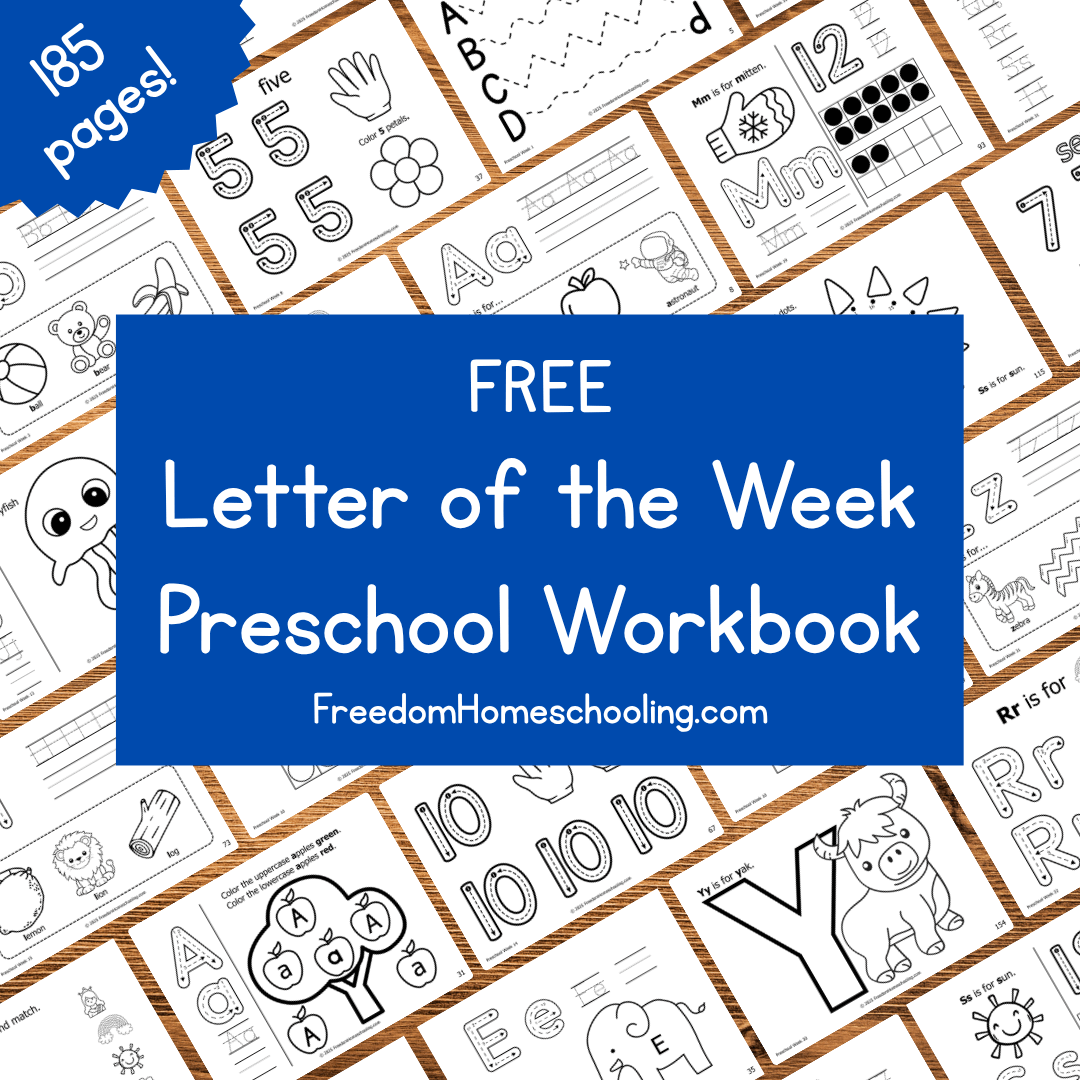
- At Freedom Homeschooling, we occasionally offer free printables that require an email list signup, like our Letter of the Week Preschool Workbook. Our email list gives us a way to tell readers when we add new free homeschool curriculum to the website, announce giveaways, share blog posts, and provide other updates.
Public Domain Books
A public domain book is a book with no copyright, a book that was created without a license, or a book where the copyright has expired or been forfeited. In most countries, a book’s copyright expires on the first day of January, 70 years after the death of the latest living author. In the United States, all books published before 1930 are in the public domain. Many free homeschool curriculum websites use vintage books and textbooks that have entered the public domain.
Examples of Public Domain Books
- Easy Peasy All-in-One Homeschool’s reading courses use vintage readers and novels that have entered the public domain.
- Ambleside Online’s curriculum includes many public domain fiction and nonfiction books and textbooks.
- At Freedom Homeschooling, we link to free public domain books fairly often. For example, our Free Vintage Graded Readers posts include links to over 40 vintage readers series for kindergarten through middle school.
- Search Project Gutenberg, Internet Archive, and Google Books to find more public domain books.
Volunteer Contributions
Volunteers who enjoy sharing their knowledge and skills teach many free online courses. Many other online resources have also been created by volunteers who want to make resources accessible to more people.
Examples of Volunteer Contributions:
- Virtual Homeschool Group is a free online homeschool co-op. The courses are taught by parents who volunteer their time. Volunteers also help with other aspects of running the co-op. Children of parents who volunteer or donate may enroll in classes before enrollment opens to the general public.
- LibriVox offers an extensive collection of free public domain audiobooks. These audiobooks are all read and recorded by volunteers.
Online Public Schools
Most school districts offer some form of tuition-free online or virtual school. These programs are taxpayer-funded public schools that your child attends from home. Online public schools should not be confused with independent home education or considered a source for homeschool curriculum. If your child is enrolled in one of these schools, they are a public school student.
Examples of Online Public Schools:
- K12
- Connections Academy
There are countless ways curriculum can be free!
There are many other reasons why homeschool curriculum can be free. While I haven’t been able to cover all of them in this post, I’ve attempted to go over the most common methods for funding free curriculum and some of what motivates individuals, businesses, and nonprofits to offer free curriculum and other educational resources. Also, you will probably notice that many websites, including some of my examples, use multiple methods to fund the free resources they offer.
Examples of other ways homeschool curriculum can be free:
- Resources funded all or in part by parent donations or “pay what you can” pricing
- Free courses sponsored by universities and colleges
- Free Creative Commons textbooks
- Curriculum sponsored by churches and other religious organizations for the purpose of religious instruction or evangelism
In Conclusion
Yes, there may sometimes be a bit of a “catch” to free homeschool curriculum, but that’s not always a bad thing. Free materials do take a lot of time and resources to create, and there are costs associated with hosting and maintaining a website. So, it’s understandable that the creators of these resources often seek to be compensated in some way. As a parent, it’s important to consider how a free resource is funded, why it’s offered for free, and evaluate the quality of the resource the same way you would materials you pay for.
Related Posts
- I can’t use free curriculum because…
- What curriculum should I use?
- Cathy Duffy Reviews Free Curriculum
Our Blog
At the Freedom Homeschooling Blog, you'll find homeschool resources and information, tips for homeschooling on a budget, encouragement, and more! Please follow us on Facebook, Pinterest, and Instagram.
Follow Us